
The Process
Our Technology
How thermal modification transforms ordinary wood.
The Science
What Is Thermal Modification?
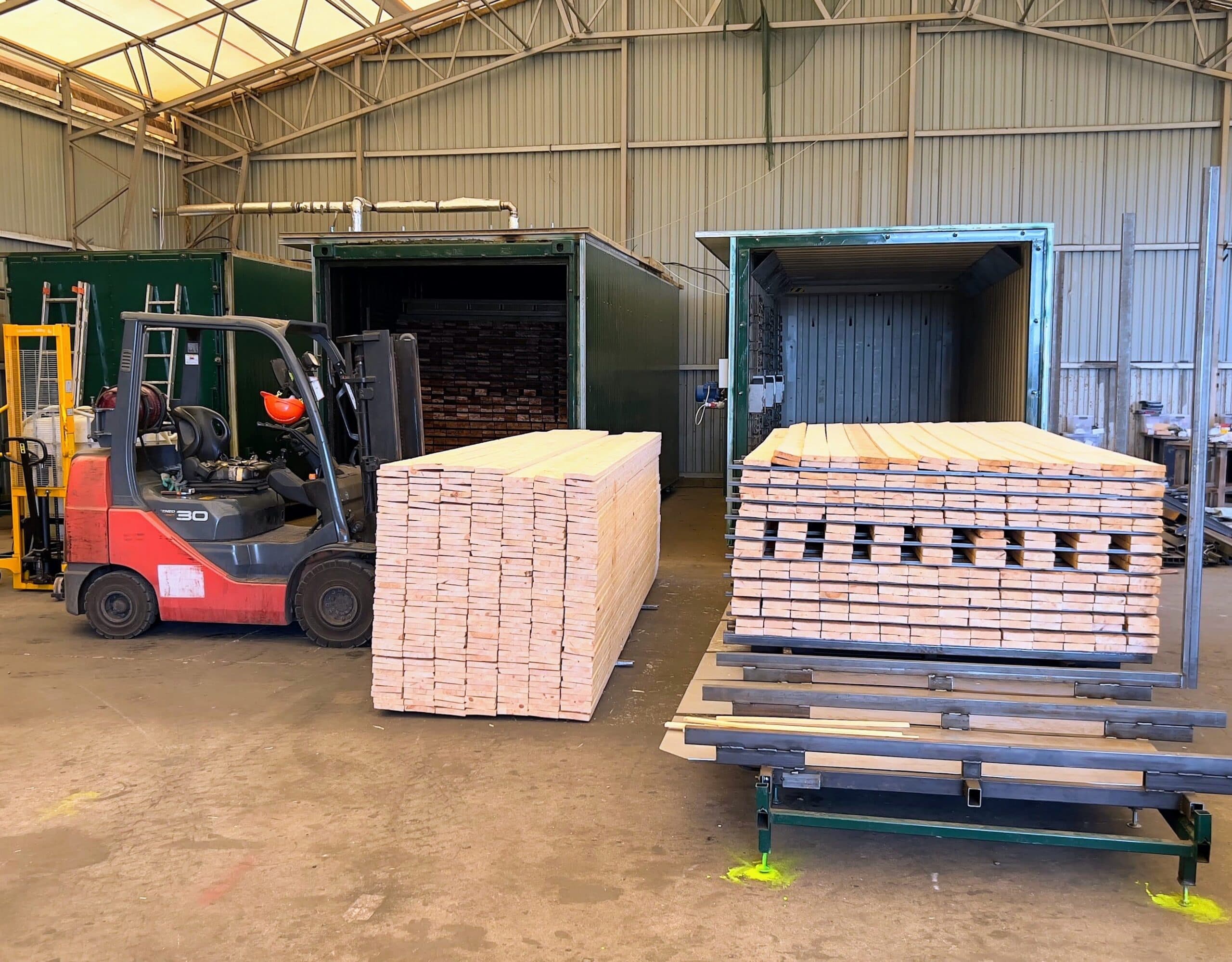
Thermal modification is a purely physical process — no chemicals, no additives. Raw timber is heated to between 185°C and 215°C in a controlled kiln environment. At those temperatures, the wood’s cell structure undergoes permanent change.
The hemi-cellulose in the cell walls breaks down and reforms. The result is a material with fundamentally different properties: it no longer absorbs or releases moisture the way untreated wood does, it no longer feeds decay fungi, and it remains dimensionally stable across seasons and climates.
01
Drying Phase
The timber is slowly dried to eliminate excess moisture. Controlled temperature ramps prevent stress fractures and prepare the cellular structure for permanent transformation.
02
Heat Treatment
Wood is heated to 185–215°C in a sealed kiln. The intense heat permanently alters cell walls — removing the sugars fungi feed on and drastically reducing water absorption.
03
Conditioning
Temperature drops gradually while moisture is carefully reintroduced. This stabilises the wood fibres and restores flexibility before the board leaves the kiln.
Side by side
Before & After
Untreated Pine
- Requires chemical preservatives for outdoor use
- Absorbs moisture, leading to swelling and warping
- Typical outdoor lifespan of 10–15 years
- Needs re-sealing every 1–2 years
Thermally Modified
- No chemicals required — heat alone drives the change
- Up to 50% lower moisture absorption than untreated
- Proven outdoor lifespan exceeding 25 years
- Simple annual oiling maintains appearance
See The Results
Explore our full product range or request physical samples to judge the quality yourself.